Welcome to another installment of Keeps Me Up at Night. Tonight, I wanna talk about a holiday classic. Beloved amongst ‘90’s kids and gen-Zers. Meme-fodder in recent years.
Yes, I am talking about… How the Grinch Stole Christmas (2000), dir. Ron Howard.
Some of you know the live-action Grinch for the memes it contributed to the internet. Such as…


And this ―

And this ―

And many more hilarious moments.
Whether it’s his schedule of wallowing in self-pity, or his difficulties picking an outfit, the Grinch has become a children’s media character that young adults find relatable. He’s misanthropic, silly, chaotic and loathsome. These are qualities we might hate in an actual person but are endearing characterized within the Grinch.
Unlike the Dr. Seuss’s book and Christmas TV special of the same name, the Grinch was given a backstory to explain why he became like *that*.
The Grinch was raised by two elderly ladies who found him on their doorstep. He attended school with the other Who kids but was bullied for his hairy appearance and crush on Martha May Whovier (who reciprocates his feelings).
One day he decides to shave himself after building a Christmas present for Martha May. When the class see his appearance, they ridiculed him — even the teacher. Upset and angry, the Grinch completely wrecks Martha May’s present and the classroom, before running off into the snowy mountains. This sparks his deep hatred of Christmas.
Fast-forward to the present: the Grinch is an adult who hates Whoville (alphabetically); and Cindy Lou Who is a child who questions all the excessive gifting. This leaders to her learning about the Grinch/his story. Cindy nominates him to be the Holiday Cheermeister, which he accepts.
At the Jubilee, Augustus, his former bully, proposes to Martha May, the Grinch’s childhood crush, in front of him. He offers a large diamond engagement ring and a brand-new car financed by Whoville taxpayers. This completely takes the spotlight away from the Grinch, who saunters off to the car they’re offering Martha May and scratches it.
Once he grabs the town’s attention, he goes on a cynical monologue criticizing the avarice and consumption from the Whos.
To textualize his words:
That's what it's all about, isn't it? That's what it's ALWAYS been *about*! Gifts. Gifts... Gifts, gifts, gifts, gifts, gifts, gifts! You wanna know what happens to your gifts? They all come to me. In your garbage. You see what I'm saying? In your GARBAGE! I could hang myself with all the bad Christmas neckties I found at the dump! And the avarice…
The avarice never ends! "I want golf clubs. I want diamonds. I want a pony so I can ride it twice, get bored and sell it to make glue." Look, I don't wanna make waves, but this *whole* Christmas season is stupid, stupid, stupid!
In context it’s interesting and makes sense. The Grinch basically lives in Whooville’s landfill in the mountains. He receives their garbage — filled with gifts the Whos desired and grew bored of. And it’s interesting that it’s placed in a kid’s film.
In a recent video, YouTube Channel ModernGurlz coins a film genre, “kinder camp,” as adaptations of familiar children’s media with bright, colorful sets/costumes, campy/overstated performances, with satire and meta-commentary about the original. The Grinch falls in this category and was featured in the video. (Check out her channel, she’s amazing.)

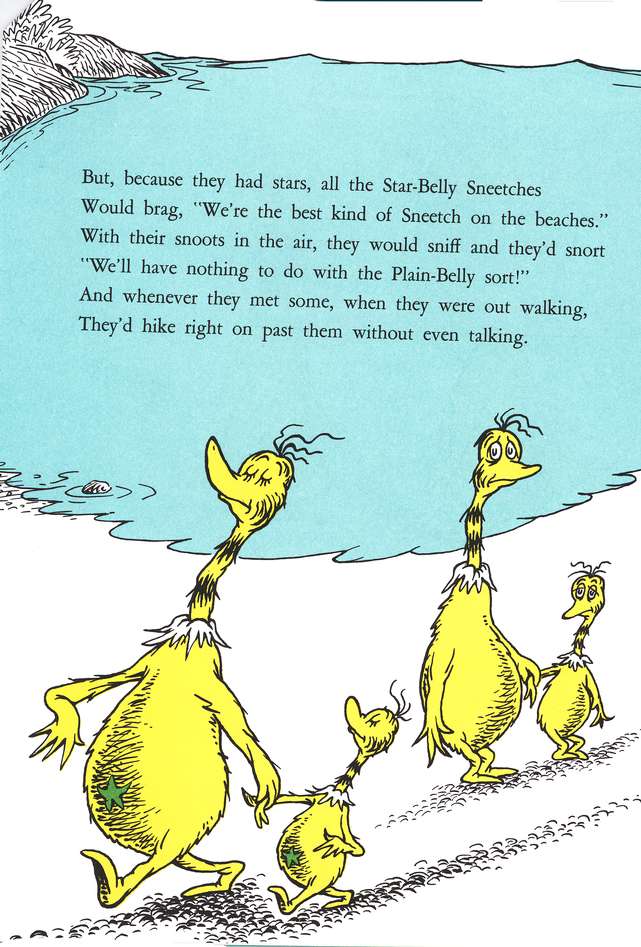
Dr. Seuss has political messages in his children’s books. The Lorax is a cautionary tale about environmental collapse and,The Sneetches and Other Stories has a tale about socially othering people based on appearance (racism).
Seuss’s message from HTGSC, paired with the screenplay written by Jeffrey Price & Peter S. Seaman (they wrote Who Framed Roger Rabbit’s screenplay), was a perfect blend of humor and commentary.
Aside from the “Gifts, gifts, gifts,” moment in Whoville, The Grinch makes jabs at the incessant consumerism of the Whos.
But in the end, The Grinch was proven both wrong and kind of right. He stole everyone’s packages, boxes, and bags, and yet the Whos still gathered to sing and be together on Christmas morn. Christmas is still Christmas without the presents (the cause of the consumerism). He didn’t see the true meaning of it till the last second: each other, the community that had previously shunned him.
At the end of the day, it is a kid’s film. And looking back at as an adult, I’m not justifying The Grinch’s deeds, but if I were a kid belittled and shunned for my appearance, I’d sabotage the Whos too. They were way in the wrong for that. But it’s still a kid’s film.
Presents or not Christmas will arrive no matter what… as will the collapse of the environment and the revolution.

If you wanna know more about the political message from The Grinch, these are my sources:
“How Dr. Seuss Gave Us One Of The Most Complex, Socially Important Heist Stories Ever” by Olivia Rutigliano
“The Red Carpet Christmas Special: How Comrade Grinch Struggled Against Christmas“ by Red Fight Back
“It started in low. Then it started to grow.”: On the Failed Anti-Capitalism of How the Grinch Stole Christmas” by Cavan W. Concannon
Have a great holiday night!
Discover more from
Subscribe to get the latest posts sent to your email.
 keepsmeupatnight.com
One thought on “The anti-consumerist message in How the Grinch Stole Christmas”